A Barefoot Boy Stopped Me in an Accra Park. When I Dug Into My Daughter’s Diagnosis, I Uncovered a Betrayal Worth $80 Million.
Marcus Bennett had bought everything a man could buy.
Hospitals.
Politicians.
Judges.
Silence.
At least, that was what the newspapers said.
They called me the king of West African logistics, the man who could move gold, grain, medicine, and votes across borders before breakfast. I owned ports in Tema, warehouses in Lagos, shipping contracts in Dubai, and enough private equity to make ministers answer my calls on the first ring.
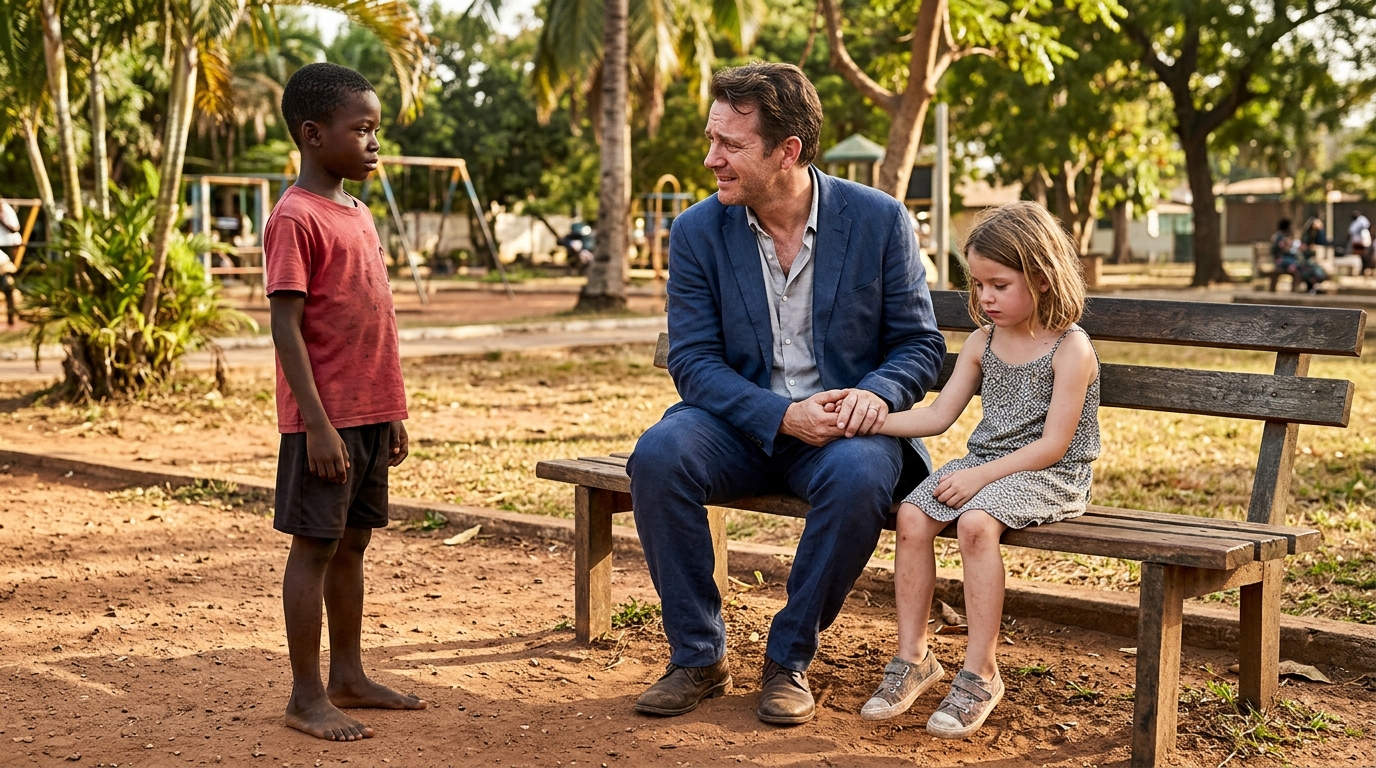
But none of it mattered when my seven-year-old daughter looked up at me in an Accra park and asked if the sun had already gone down.
It was 5:18 p.m.
The sky was burning gold.
The whole world was light.
Lila sat beside me on a shaded bench near a dry fountain, one hand wrapped around mine, the other clutching the small white cane her doctors had insisted she start using. She had always hated that cane. Not because it embarrassed her. Because it made the adults around her speak in softer voices, as if she had become fragile overnight.
Six months earlier, Lila could read chapter books under her blanket with a flashlight.
Four months earlier, she started bumping into doorframes.
Two months earlier, she asked why the moon had edges.
Now she could no longer see my face unless I leaned close enough for her to touch my cheek.
I had flown in specialists from London, Dubai, New York, and Johannesburg. Every one of them said the same thing in a different accent.
Progressive optic degeneration.
Rare.
Aggressive.
No reliable treatment.
My wife, Adelaide, handled it all with a calmness people admired. She organized medications, scheduled consultations, managed nurses, and learned the exact tone grieving mothers used to receive sympathy without asking for it.
Everyone called her strong.
I called her a miracle.
That evening, she had stayed behind at our Cantonments house to prepare Lila’s evening drops. I had taken Lila to the park because she wanted air. Real air, she said. Not the kind that came from air-conditioning vents and hotel lobbies.
So we sat near the broken fountain, listening to traffic beyond the trees, while the sunset painted the pavement warm.
“Daddy,” Lila whispered, “is it nighttime already?”
I lied.
“Almost, sweetheart.”
Her fingers tightened around mine.
Then a voice behind us said:
“Your daughter is not sick.”
I turned.
A boy stood barefoot near the fountain.
Thin.
Dust on his knees.
A torn red shirt hanging off one shoulder.
He could not have been more than twelve, but his eyes had the stillness of someone who had learned to watch adults before trusting them.
I stood immediately.
“What did you say?”
The boy did not run.
“She isn’t going blind,” he said.
His gaze moved from me to Lila.
“Someone is taking her sight.”
The park seemed to lose all sound at once.
I stepped toward him, anger rising because fear needed somewhere to go.
“What are you talking about?”
The boy looked directly into my eyes.
Then he said one word that made my blood turn cold.
“Your wife.”
The Boy Beside the Silent Fountain
For a moment, I forgot how powerful men were supposed to behave.
I forgot the bodyguard waiting by the black Range Rover.
I forgot the driver watching from across the path.
I forgot the mothers near the playground who had turned to stare.
All I could see was a barefoot boy accusing my wife of slowly destroying my child.
I grabbed his arm.
Not hard.
But fast enough that Lila gasped.
“Who sent you?” I demanded.
The boy did not flinch.
“No one.”
“What is your name?”
“Kojo.”
“Kojo what?”
He looked away.
Children who live too close to danger understand that full names can become weapons.
Lila’s small voice cut through the moment.
“Daddy. Let him go.”
I released him.
Kojo rubbed his arm once, then reached into the pocket of his shorts and pulled out a small plastic vial.
My breath stopped.
It was identical to the vials Adelaide used for Lila’s eye drops.
Same narrow shape.
Same white cap.
Same blue strip across the label.
But this one had been peeled clean, leaving only glue marks and one partial word.
Cyclo.
I knew that prefix.
I had seen it in one of Lila’s medical reports.
Cyclopentolate.
A diagnostic dilating agent, the doctors had said. Used briefly during exams.
Not daily.
Not for months.
Kojo held the vial between two fingers.
“My sister had these,” he said. “Before she stopped seeing.”
Lila turned her head toward his voice.
“She got better?” she asked.
Kojo looked at her, and for the first time, the hardness in his face broke.
“No.”
The word was so quiet I almost missed it.
Then he looked back at me.
“My mother was a nurse at Eden Ridge Eye Centre. She found the old bottles. She said they were not what the labels claimed.”
Eden Ridge.
That was Lila’s clinic.
The private pediatric ophthalmology center Adelaide had chosen after our third London consultation. She said their founder had trained in Switzerland. She said the discretion was better. She said Lila needed privacy from newspapers and business rivals.
I had agreed because I was tired.
Grief makes a man delegate the wrong things.
Kojo looked over my shoulder.
His body changed.
Just slightly.
The way street dogs tense before a thrown stone.
I followed his gaze.
A dark Mercedes had stopped near the park entrance.
One of Adelaide’s security men stepped out.
Not mine.
Hers.
Kojo stepped back.
“You must not give her the night drops.”
“Wait.”
He moved farther away.
“Check the cabinet behind her dressing room mirror,” he said.
“What cabinet?”
But he was already walking backward toward the trees.
“Ask why the light comes back when she misses a dose.”
Then he ran.
I wanted to follow him.
Instead, Lila whispered, “Daddy?”
I crouched beside her.
Her eyes were open, unfocused, searching for me in the golden blur.
“What is it?”
She swallowed.
“I can see your shirt.”
My heart stopped.
I was wearing a white linen shirt.
For three weeks, she had not been able to tell white from black in daylight.
I lifted my hand slowly.
“How many fingers?”
She squinted.
Her lower lip trembled.
“Three?”
I was holding up three.
Behind me, Adelaide’s security man began walking toward us.
And as I looked from my daughter’s frightened face to the empty path where Kojo had disappeared, I realized the boy had not come to warn me.
He had come because he was being hunted too.
The Medicine That Made Daylight Disappear
I did not confront Adelaide that night.
That may have saved my daughter’s life.
Rich men are used to solving problems by force. Fire the lawyer. Replace the doctor. Buy the building. Ruin the enemy.
But I had built enough empires to know one truth.
The person who smiles when you are broken is never careless.
Adelaide was waiting when we returned home.
She stood at the top of the marble staircase in a pale green dress, her hair pulled back, diamonds resting against her throat like frozen tears. She looked at Lila first, then at me, then at the security man who followed a few steps behind.
“You were gone longer than expected,” she said.
Her voice was gentle.
Too gentle.
“Traffic near the park,” I lied.
Lila squeezed my hand.
Adelaide descended slowly and knelt in front of our daughter.
“Time for your drops, my love.”
“No,” Lila whispered.
Adelaide’s expression did not change.
“What was that?”
I stepped in before Lila could answer.
“She’s exhausted. Let her rest ten minutes.”
“The schedule matters, Marcus.”
“So does fear.”
Her eyes lifted to mine.
There was no anger in them.
That was worse.
“Of course,” she said.
She touched Lila’s cheek.
“Ten minutes.”
I carried Lila upstairs myself, something Adelaide disliked because she believed routines should be managed by nurses. I locked the bedroom door behind us and helped Lila sit on the bed.
“Daddy,” she whispered, “are we in trouble?”
I wanted to say no.
Instead, I said, “Not if we stay quiet.”
Her face changed.
A child should never understand that sentence.
But she did.
I went into Adelaide’s dressing room while Lila waited in the adjoining bedroom.
The mirror stretched from floor to ceiling, framed in gold. Behind it, according to Kojo, was a cabinet.
I pressed along the edges.
Nothing.
Then I noticed one hinge was cleaner than the others.
I pushed.
The mirror clicked open.
Inside was not jewelry.
Not perfume.
Not letters.
Medicine.
Rows of unmarked vials.
Syringes.
Label sheets.
A small printer.
And a locked metal case.
My hands began to shake.
I took photos of everything, then opened the nearest vial. The liquid looked harmless. Clear. Sterile. Innocent in the way poison often is.
On the shelf above it was a notebook.
Adelaide’s handwriting.
Precise.
Beautiful.
Dose adjusted after London consultation.
Vision suppression maintained.
Public decline convincing.
Father emotionally compliant.
I stared at that last line until the words blurred.
Father emotionally compliant.
That was me.
The man who could move governments.
Reduced to a note in my wife’s handwriting.
I heard footsteps outside the dressing room.
I closed the mirror silently and stepped back into the bedroom just as Adelaide knocked.
“Marcus?”
I opened the door halfway.
She looked past me toward Lila.
“It has been ten minutes.”
“She fell asleep.”
“I can do the drops while she sleeps.”
“No.”
One word.
Flat.
Final.
For the first time, Adelaide’s face hardened.
Only for a moment.
Then the softness returned.
“You are frightened,” she said. “I understand.”
“Do you?”
“I have carried this with you every day.”
Behind me, Lila made a small sound.
Adelaide’s eyes flicked toward the bed.
I stepped into the doorway, blocking her view.
“We skip tonight.”
Her lips parted.
Then closed.
“Skipping treatment could accelerate the damage.”
“Then we’ll call Dr. Okafor.”
At the mention of Lila’s lead physician, something moved behind Adelaide’s eyes.
Not fear.
Calculation.
She reached out and touched my sleeve.
“Marcus, don’t let a day of panic undo months of care.”
Her voice was warm.
Her hand was steady.
Her lie was perfect.
I almost understood how she had fooled me.
Almost.
At 2:13 a.m., Lila woke me.
I had fallen asleep sitting beside her bed.
“Daddy,” she whispered.
I leaned forward.
“What is it?”
Her eyes were open.
Tears streamed down both cheeks.
“I can see the curtains.”
The room went silent around us.
The curtains were blue.
Dark blue.
Drawn halfway across the balcony doors.
I touched her face, unable to breathe.
“What color?”
She stared for a long time.
Then whispered, “Blue.”
I held her until she slept again.
At dawn, my private investigator called from the gatehouse. I had sent him the photos from Adelaide’s cabinet, Kojo’s vial, and the name Eden Ridge.
His voice was different than usual.
Careful.
“Mr. Bennett, I found the boy.”
“Kojo?”
“Yes.”
“Bring him to me.”
There was a pause.
“We can’t.”
My stomach tightened.
“Why not?”
“Because his mother filed a police report against your wife three months ago.”
I stood slowly.
“And?”
“The report disappeared. The mother died two days later.”
He breathed once, then said the part that turned fear into rage.
“The cause of death was listed as suicide.”
The Clinic My Wife Owned Without My Name
By 8:00 a.m., I had three truths.
Kojo’s mother, Abena Mensah, had been a nurse at Eden Ridge Eye Centre.
She had filed a complaint claiming a pediatric patient was being intentionally exposed to a powerful ophthalmic drug under false labeling.
Two days later, she was found dead in her apartment.
Her daughter, Ama, who had been treated at the same clinic under a charity grant, was listed as permanently blind.
Her son, Kojo, disappeared from the foster intake system within forty-eight hours.
A vanished report.
A dead nurse.
A blind child.
A barefoot boy hiding in Accra traffic with the vial that could destroy my wife.
I went to Eden Ridge without warning.
Not with police.
Not yet.
Police reports could disappear. I had just learned that.
I arrived with my attorney, my investigator, and two men from my corporate security team who had once worked financial crimes in London. Men who knew how to remove evidence from a building before the building remembered to lock itself.
The clinic was beautiful.
That offended me most.
White walls. Glass doors. Soft lighting. A children’s mural of stars and moons above the waiting area. Nurses in pale blue uniforms moving quietly between rooms.
Parents sat in expensive chairs with frightened faces.
Hope is a profitable thing when sold tastefully.
The receptionist smiled when she saw me.
“Mr. Bennett, we weren’t expecting you.”
“No one ever expects the person they’re poisoning.”
Her smile died.
Dr. Samuel Okafor appeared within three minutes.
Tall. Immaculate. Hands folded. Voice calm.
“Marcus, this is inappropriate.”
“My daughter saw blue curtains this morning.”
His expression did not move.
But his pupils did.
A tiny widening.
Enough.
“That can happen,” he said. “Temporary light perception does not indicate improvement.”
“She skipped her drops.”
Silence.
Not long.
But real.
He recovered quickly.
“You are making dangerous assumptions.”
“Then prove me wrong. Run a full toxicology panel. Independent lab. Right now.”
“That is not clinically necessary.”
“My daughter is seven.”
His jaw tightened.
“And my clinic has protocols.”
My attorney stepped forward and placed a court order on the desk.
Dr. Okafor looked at it.
Then at me.
Then toward a hallway behind reception.
Again.
That small flick of the eyes.
The same thing guilty men do when their secrets are stored in a specific room.
My investigator noticed too.
Within fifteen minutes, we were in the records office.
Within twenty, we found the locked freezer.
Inside were vials identical to the ones in Adelaide’s hidden cabinet.
Some had patient names.
Some had numbers.
One drawer was labeled L.B.
Lila Bennett.
Another was labeled A.M.
Ama Mensah.
Kojo’s sister.
My investigator swore under his breath.
My attorney called the independent lab.
Dr. Okafor stopped pretending.
“You don’t understand what you’re touching,” he said.
I turned to him slowly.
“Then explain.”
His face had changed. The polish was gone. What remained was not guilt exactly. It was resentment. The resentment of a man who believed his genius had been interrupted by someone too emotional to appreciate it.
“The drug does not destroy the optic nerve when managed correctly,” he said. “It induces controlled functional blindness. Reversible in most cases.”
In most cases.
I felt my hands close into fists.
“You blinded children.”
“I preserved leverage.”
The room went dead quiet.
My attorney stared at him.
“Leverage for whom?”
Okafor’s eyes shifted again.
Not to the hallway this time.
To my wife’s name in the records.
Adelaide Bennett.
Listed not as emergency contact.
Not as parent.
As private research fund administrator.
I looked closer.
At the ownership file.
Eden Ridge Eye Centre was funded through three shell companies.
One was controlled by a foundation I had never heard of.
Adelaide Heritage Trust.
My wife owned the clinic.
Not directly.
Not visibly.
But completely.
My phone rang.
Adelaide.
For a moment, I simply watched her name glow on the screen.
Then I answered.
Her voice was soft.
“Marcus.”
I did not speak.
“I need you to leave Eden Ridge.”
“Why?”
“Because you are standing in the middle of something that can still be repaired.”
I looked at the drawer marked L.B.
“My daughter’s sight?”
A pause.
“Our family.”
The word family sounded obscene from her mouth.
Behind her voice, faintly, I heard a child crying.
Not Lila.
A girl.
Older.
My heart slammed once.
“Where are you?”
Adelaide exhaled.
“You should have trusted me.”
The line went dead.
Thirty seconds later, my security chief called from the house.
His voice broke.
“Sir, Mrs. Bennett is gone.”
My hand tightened around the phone.
“And Lila?”
A silence opened.
Too long.
Too empty.
Then he said the words no father survives unchanged.
“She took Lila with her.”
The Trust That Needed a Blind Child
I used to think panic was loud.
It isn’t.
Real panic is surgical.
It cuts away everything unnecessary.
By noon, my phones, bank contacts, airport liaison, port security, private investigators, and federal connections were moving. Every aircraft tied to Adelaide was grounded. Every border alert was triggered. Every driver on our payroll was questioned.
But Adelaide had planned better than fear.
She did not use a jet.
She did not use a company vehicle.
She did not touch her main accounts.
She vanished through charity infrastructure.
An ambulance registered to Eden Ridge left the clinic’s rear entrance at 9:42 a.m. It carried one adult female, one minor female, and two medical staff. Destination listed as Cape Coast Pediatric Outreach.
The ambulance never arrived.
At 1:10 p.m., Kojo appeared at my gate.
Dirty.
Shaking.
Alive.
My guards nearly turned him away.
I ran outside myself.
He looked smaller in daylight.
More exhausted.
But his eyes were fierce.
“She took her to the old children’s home,” he said.
“What children’s home?”
“Near Winneba. The one Eden Ridge used before.”
“How do you know?”
His face twisted.
“Because that is where they kept my sister when she stopped getting better.”
I brought him inside.
He refused water at first, as if accepting anything might cost him later.
Then he told me everything.
His mother had discovered that Eden Ridge was not treating certain children. It was classifying them. Some were charity cases used for research. Some were children of wealthy families whose medical conditions triggered trusts, insurance payouts, inheritance clauses, or custody advantages.
Blindness was useful.
A blind child required lifetime care.
A blind child activated disability protections.
A blind child made a parent look devoted.
A blind child could move money without suspicion.
Lila was not just a victim.
She was the key.
My father, Elias Bennett, had left an $80 million family legacy fund to Lila before he died. I had always thought it was sentimental. He adored her. He said she had kinder eyes than anyone in our family.
But the trust had one clause I had never read closely.
If Lila became permanently medically incapacitated, her primary care guardian would gain operational control over the fund for treatment, accessibility, and lifelong care planning.
Primary care guardian.
Not father.
Guardian.
Adelaide had been building that role for months.
Doctors praised her.
Nurses documented her devotion.
Specialists recorded her as the managing parent.
While I flew between boardrooms and hospitals, she became the face of Lila’s suffering.
In three days, Lila had a final neurological-ophthalmic evaluation scheduled.
Permanent certification.
Once signed, the fund would move.
Eighty million dollars.
Controlled by Adelaide.
Backed by Eden Ridge medical records.
Justified by my daughter’s manufactured darkness.
I looked at Kojo.
“Why did you come to the park?”
He reached into his pocket and pulled out another folded paper.
A photograph.
Abena Mensah, his mother, wearing a nurse’s uniform, standing beside Lila in a clinic playroom.
On the back was a note.
If anything happens to me, find Marcus Bennett. He is blind too, but not like the children.
I read it twice.
Then a third time.
He is blind too.
My throat closed.
Kojo looked away.
“My mother said powerful men don’t see what happens inside their own houses.”
She was right.
At 3:26 p.m., we found the ambulance.
Abandoned.
Burned near a side road outside Kasoa.
No bodies.
That was the only mercy.
My investigator recovered one thing from the ash beneath the rear seat.
Lila’s white cane.
Bent in half.
I held it in both hands and felt the world inside me go silent.
Then my phone rang.
Unknown number.
I answered.
For a second, there was only wind.
Then Lila’s voice whispered:
“Daddy?”
I nearly broke.
“I’m here, sweetheart.”
“She says you don’t want me if I can see.”
My vision went red.
“Listen to me, Lila. That is a lie.”
Adelaide’s voice came onto the line.
Calm.
Smooth.
Almost sad.
“You could have had everything, Marcus. You only had to keep believing what you were told.”
“Where is she?”
“She is safe.”
“If you harm her—”
“I protected her from becoming like you.”
Her voice sharpened.
“Owned by men. Watched by men. Used by men. Your father wrote that trust to keep me begging at your table forever.”
“This is about money?”
“No,” she said softly. “Money is only what men understand.”
A pause.
Then the final mask fell.
“This is about control.”
The line clicked dead.
Kojo stood beside me, staring at the phone.
Then he whispered, “I know where she is.”
The Morning Lila Saw the Sun Again
The old children’s home stood beyond a dirt road lined with coconut palms and broken fencing.
Once, it had been painted yellow.
Now the walls were stained by rain and salt air. Windows covered with rusted bars watched the road like dead eyes. A faded sign hung crooked above the gate.
Eden Hope Outreach Centre.
Hope again.
They loved that word.
Police wanted to wait for a warrant team.
I did not.
That was not courage.
It was arithmetic.
A child can disappear forever in the time adults spend asking permission from systems already corrupted.
Kojo led us through a drainage path behind the compound wall. He knew the gaps. The blind spots. The window that never locked.
Inside, the building smelled of disinfectant, damp mattresses, and fear.
We found three children in the first dormitory.
Two girls.
One boy.
All with eye bandages.
All alive.
The youngest cried when my investigator lifted her.
In the treatment room, we found Ama.
Kojo’s sister.
She sat on a cot with her head turned toward the doorway.
Her eyes were cloudy, but not empty.
Kojo made a sound I will never forget.
Not a cry.
Not a word.
Something torn from the deepest place a brother has.
Ama stood when she heard him.
“Kojo?”
He ran to her.
For one second, I watched them hold each other and understood that my nightmare was not unique.
It was simply better funded.
Then I heard Lila scream.
I ran.
Down a corridor.
Past peeling paint.
Past a locked pharmacy.
Past a room filled with files stacked in plastic crates.
At the end of the hall, Adelaide stood beside a metal examination chair.
Lila was strapped to it.
Dr. Okafor stood nearby with a syringe in his hand.
My daughter’s eyes were open.
Terrified.
But when she saw movement in the doorway, she turned her head toward me.
Not toward my voice.
Toward me.
“Daddy?”
I stopped breathing.
She saw me.
Adelaide saw it too.
Her face changed.
Not with guilt.
With fury.
“You skipped the drops,” she said.
I stepped into the room.
“Let her go.”
Okafor raised the syringe.
My security chief lifted his weapon.
Everything froze.
Adelaide placed one hand on Lila’s shoulder.
“She will never thank you for this,” she said. “The world devours girls who can see too clearly.”
“Do not dress greed as protection.”
Her eyes flashed.
“You think this was greed?”
“You blinded my child for a trust fund.”
“I built a life you took credit for.”
“You poisoned children.”
“I made myself necessary.”
There it was.
The truth beneath every lie.
Not illness.
Not tragedy.
Not sacrifice.
Necessity.
Adelaide had built a world where everyone needed her. Lila needed her drops. Doctors needed her funding. Charities needed her name. I needed her calm.
And when Lila’s sight returned, the entire kingdom collapsed.
Police stormed the room from the rear entrance twenty seconds later.
Okafor dropped the syringe.
Adelaide did not run.
She simply looked at Lila, then at me, and smiled with a coldness I still see in dreams.
“She will remember who was there every day,” she said.
I moved to Lila as officers restrained my wife.
My hands shook so badly I could barely unfasten the straps.
Lila touched my face.
Her fingers moved over my eyebrows, my nose, my mouth.
Then her eyes widened.
“Daddy,” she whispered.
“Yes.”
“Your shirt is white.”
I broke.
Completely.
The trials lasted almost a year.
Eden Ridge fell first. Its records exposed a network that touched private clinics, orphan charities, insurance handlers, and two court officers who had helped bury Abena Mensah’s complaint.
Dr. Okafor testified in exchange for a reduced sentence and named every funder, every shell company, every child enrolled in what he called “vision suppression protocols.”
The court called it aggravated child abuse, medical fraud, kidnapping, and conspiracy.
I called it what it was.
A marketplace for suffering.
Adelaide refused to plead.
She entered court every morning dressed like a widow, head high, expression serene. She never apologized. Not to Lila. Not to Kojo. Not to Ama. Not to the families who sat behind me holding children who had been used as documents before they were treated as human beings.
On the final day, Lila asked to speak.
She was eight by then.
Her vision had mostly returned, though bright light still hurt. She wore tinted glasses and held my hand as she walked to the front of the courtroom.
Adelaide watched her carefully.
For one terrible second, I feared my daughter would soften.
Children love even the people who harm them if those people tuck them in afterward.
But Lila stood straight.
“My mother told me darkness was part of me,” she said.
Her small voice trembled.
Then steadied.
“But it was something she gave me.”
The courtroom went silent.
Lila turned slightly toward Adelaide.
“I am giving it back.”
Adelaide’s face cracked.
Only once.
Only for a second.
But I saw it.
So did the judge.
She received fifty-two years.
Okafor received thirty.
Eden Ridge was shut down, seized, and later rebuilt under court supervision as a real rehabilitation center for the children it had harmed.
Kojo and Ama came to live with us six months after the trial.
Not because I was trying to be a savior.
Because Abena Mensah had saved my daughter before I even knew she needed saving, and debts like that cannot be paid with money.
Ama’s vision never fully returned.
But some light did.
Enough to see her brother’s face.
Enough to read large letters.
Enough to watch the sea if the sun was gentle.
Lila recovered faster. Children often do what adults call impossible because no one has taught their bodies to obey despair.
One year after the park, she asked to go back to the broken fountain.
The city had repaired it by then.
I paid for the restoration anonymously, though everyone knew.
Water flowed again from the stone basin. Children ran around it laughing. Mothers sat under the trees. The late afternoon sun turned the spray into gold.
Lila stood beside me without her cane.
Kojo sat on the fountain’s edge, shoes still optional despite every pair I had bought him. Ama sat beside him, her face tilted toward the water, smiling at the sound.
Lila looked up at me.
“Daddy?”
“Yes, sweetheart.”
“Is it nighttime already?”
My chest tightened.
She smiled.
Then pointed toward the sky.
“I’m joking.”
For a moment, I could not laugh.
Then I did.
So hard I had to sit down.
Lila climbed into my lap the way she used to when she was smaller, before doctors and darkness and betrayal had entered our home. She placed both hands on my face and studied me carefully.
“You look older,” she said.
“I am older.”
“You look sad.”
“I was.”
“And now?”
I looked at the fountain.
At Kojo.
At Ama.
At the water moving again through stone that everyone had thought was useless.
“Now I can see better.”
Lila leaned against my chest.
The sun was lowering over Accra, warm and bright and impossible to mistake for night.
For months, I had believed my daughter was losing the world.
The truth was worse.
Someone she loved had been stealing it from her drop by drop.
But truth has a way of surviving inside the people we overlook.
A barefoot boy.
A dead nurse’s note.
A child who noticed daylight returning when the poison stopped.
I had ruled industries, swayed politicians, and bought the finest doctors money could reach.
But none of them saved Lila.
Kojo did.
Abena did.
Lila did.
And when my daughter lifted her face toward the gold sky and whispered, “It’s bright, Daddy,” I finally understood the thing power had kept me from learning.
A man who owns everything can still be blind.
And sometimes, the poorest child in the park is the only one who can see the truth.